

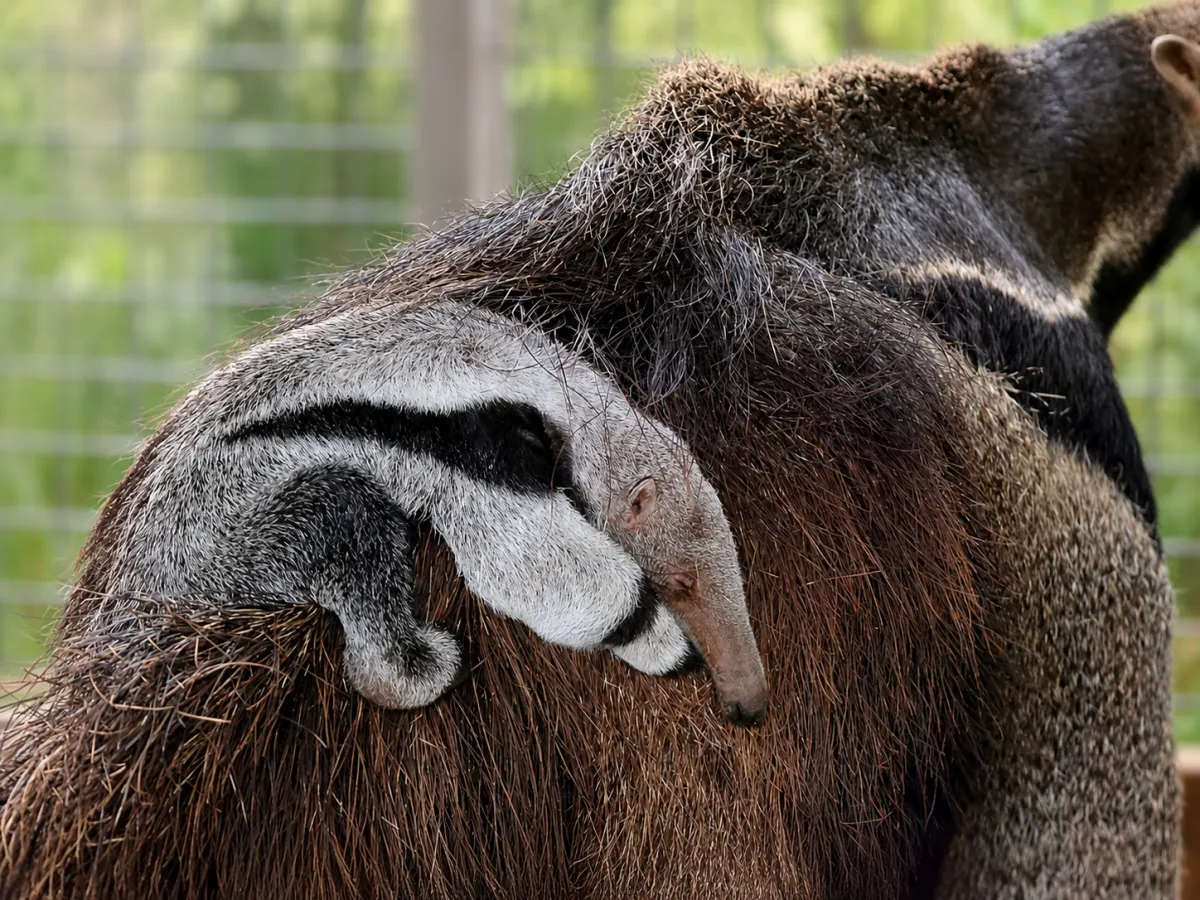
Rare Giant Anteater Born at Tanganyika Wildlife Park
Only two giant anteaters were born in North America last year. The next one arrived in Goddard, to a pair the staff had nearly given up on.
Information courtesy of Tanganyika Wildlife Park
Photo credit courtesy: Tanganyika Wildlife Park
GODDARD, Kan. (July 31, 2026): Tanganyika Wildlife Park (tang-uh-NEE-kuh) has welcomed a giant anteater pup, born overnight in July to mother Amara. The birth is an uncommon one. Only two giant anteaters were born in North America in all of 2025, across roughly 65 facilities that hold the species. The pup arrived days after the park's giraffe calf, Milani, during Tanganyika's 18th birthday season.
The pregnancy took the staff by surprise. Amara had been paired on and off with the park's male, Armando, for two years without result. At roughly the five-month mark, keepers watched Amara begin pushing Armando out of shared space, a behavior typical of a solitary species as a female nears birth, and moved him to a separate enclosure. Amara delivered standing fully upright, braced on her tail, which is how giant anteaters give birth.
"This has been a demanding season for our care team. They have been through a lot in a very short window, and they have carried it while still showing up for every animal here, every single day," said LynnLee Schmidt, Integrator at Tanganyika Wildlife Park. "A birth like this one is the reminder of why the work matters. It does not happen by luck. It happens because people are paying close attention when it would be easier not to."
The pup now rides on its mother's back and will stay there for the next six to twelve months. Its stripe pattern aligns with the black shoulder stripe of its mother, so that from a short distance the two animals read as a single silhouette. The pup is nursing regularly and Amara is rearing it without assistance. Its sex has not yet been determined and it has not been named.
"Most people have never seen a giant anteater, and the ones who have usually have it wrong. They are odd looking, they are badly misunderstood, and they are one of the most remarkable animals on the planet," Schmidt said. "Getting to introduce a baby one to the world is the whole reason we do this."
Amara and her pup are viewable during morning hours. Tanganyika Wildlife Park is located in Goddard, Kansas, about 20 minutes west of Wichita, and is open daily during the season. More information is available attwpark.com.

Giant anteaters are listed as Vulnerable on the IUCN Red List, with roughly 5,000 remaining in the wild. Populations continue to decline across Central and South America, driven by habitat fragmentation, grassland fires, vehicle strikes and attacks by domestic dogs. Because the species raises one offspring at a time and reaches independence slowly, every birth in professional care carries weight for the managed population.
About Tanganyika Wildlife Park
Tanganyika (tang-uh-NEE-kuh) Wildlife Park is a family-owned and operated wildlife park in Goddard, Kansas that aims to promote conservation and education through its collection of rare and endangered animals. The park is home to over 400 animals from 100 different species, including many not commonly found in zoos or wildlife parks. Tanganyika is dedicated to connecting people with wildlife and encouraging them to become stewards of the environment. The park offers a range of educational programs and experiences, such as behind-the-scenes tours, animal encounters, and wildlife camps. Tanganyika Wildlife Park has received numerous awards for its commitment to animal welfare and conservation and is a proud member of the Zoological Association of America (ZAA) and certified by the American Humane Association (AHA).
